Showing posts with label carboy. Show all posts

Tuesday, August 11, 2015

Carboy and Keg Washer

We got a new piece of cleaning equipment and it works great.  It is the Mark II Keg and Carboy Washer and is basically a pump attached to a sprayer tube with a basin and stand.  I ran the primary fermentors from the Pale Ale through it with some hot water and Oxy Clean Free and was pleased with the results.  It still requires using a carboy brush for the caked on yeast from the krausen, but saves time and water and I am pleased with it.  There are some attachments that allow you to run cleaning solution through hoses as well that I will test out soon.

Here's a shot of the 10 gallon batch of Pale Ale with split Conan (Alchemist) and Pacman (Rogue) yeast in the secondary fermentors.
They both clocked in at 1.010 from 1.052, which will be 5.5% ABV.  I used 90.3% Rahr American 2-row base malt with 2.2% German Carared (24L), 3.2% American Caramel-10, and 4.3% American Carapils malts.  The hops are a "clean out the freezer" method with some Apollo, Centennial, Citra, Simcoe, Pine Fruit, Jarrylo, and Columbus.

I will dry hop these for a week and get them into kegs once we kick the leftover Rye Pale Ale from our field party.

Cheers!

Thursday, July 23, 2015

Brewery Update

Due to the lengthy summer vacation absence and our computer being in the repair shop, it has been a while since our last post.  Here's a new logo I have been working on:

Keg Party

The Rye Pale Ale and American Pale Ale were successfully served at a party in Maryland on July 13.  They both tasted great and we had many compliments from the Bud Light crowd.  I had several issues with the liquid dip tube and post clogging continuously on one of the kegs, so we had to improvise and rest the keg on it's side.  I will be evaluating options for fixing the issue, such as a dip tube screen or stainless steel scrubby pad over the end and possibly shortening the tube an inch.  We camped out at the party, but somehow lost our air mattress pump, so having the CO2 tank proved valuable as it was used to fill the mattress!  It is amazing how much gas is in that 5 pound tank.

Fermentors

There is beer in three of the secondary carboys.
  1. Imperial Stout made on 6/7 with an OG of 1.090
  2. American IPA made on 6/23 with an OG of 1.071
  3. American Amber Ale made on 7/2 with an OG of 1.057
Next week, we will dry-hop the IPA and Amber and prepare some secondary additions for the imperial stout.  I am thinking cacao nibs, some mild chile peppers, and possibly some cinnamon.

There is beer in two of the primary carboys.  This was a 10-gallon batch split with different yeasts with a 1.052 original gravity.
  1. American Pale Ale brewed on 7/4 with Giga Yeast GY054 Vermont IPA yeast
  2. American Pale Ale brewed on 7/4 with Wyeast Pacman yeast
Because I turned off our A/C during our week-long trip, the basement temperature rose from it's typical 64F, which will influence the amount of dissolved CO2 in solution and therefore the amount of priming sugar needed for bottle conditioning.  Because of that, I plan to keg as many of these as I can and may either CO2 force carbonate them or do a combination sugar carbonation and CO2.

I will be working on my brew day video soon.

Cheers!

Wednesday, February 25, 2015

Three Pale Ales

These are all the beers left in the pipeline. One gets bottled and two get dry hop/secondaried this weekend.


This is my new favorite video.

Friday, January 30, 2015

Hard Way IPA Brew Day

Today was the brew day for a kegged beer to enter in the People's Choice Award contest for the Peach State Brew Off presented by the Covert Hops Society on 2/28/14.


It was a windy day, but the trusty Blichmann burner powered through.


There was a lot of steam!


After chilling, this golden beauty was racked to the carboy.


The yeast for this batch is Safale US-05 American Ale.  After it is finished fermenting and dry hopped, we will bottle a few using carbonation drops and keg the remainder.

Saturday, December 6, 2014

Novembrews

We made it a Brewvember to remember.


Black Rye Ale:

Barreled Black Rye:


Citra IPA:

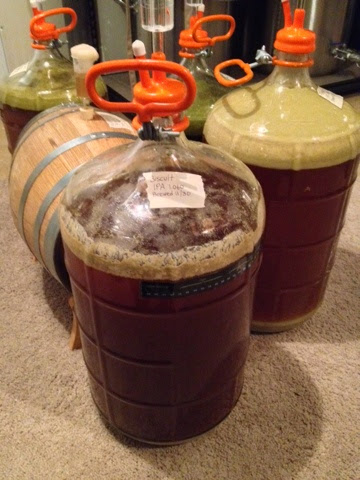
Biscuit IPA

Mosaic IPA:

25 beautiful gallons...

Saturday, November 22, 2014

Citra IPA Brew Day

Today, we brewed an all Citra Hop American IPA. This is batch 9 of this recipe, with small tweaks along the way.  The last batch scored second place for American style IPAs at the Music City Brew Off AHA BJCP homebrew competition in Nashville on 11/8/14.

The malt in the recipe was American 2-row Pale Malt as the base with Munich for breadiness/maltiness, Crystal 10L for light sweetness, Carafoam for body & head, & Melanoidin for sweet toastiness.  The hops were of course all Citra added as First Wort Hops, then 60, 15, 10, 5, 0, & Dry Hops.  The mash was a single infusion which rested at 152F.  We did a single batch sparge and 60 minute boil.  After chilling and racking to the carboy, we pitched Safale S-04 English yeast at 9pm into the 1.062 original gravity (OG) wort.

Tuesday, October 28, 2014

Extra Special Bitter Brew Day

We brewed an English Pale Ale (aka ESB) today using White Labs 005 English Ale yeast.  The color looks great and we can't wait to try the finished product.

This is the kettle with the chiller and auto-siphon after racking was complete.


The color looks very caramel/toffee:


We are looking forward to this one!

Saturday, October 4, 2014

Rye Pale Ale Brew Day

Today was the brew day for a Pale Ale with Rye, inspired by Spike Buckowski at Terrapin.  I am happy with my current process and wanted to photo document the many steps involved during Brew Day.

Heating the strike water is always first.  We always get that going early while working on the recipe formulation, gathering ingredients, and other things.


Next is milling the grains.  We usually do this during the 30 minutes the strike water is heating up to the calculated temperature ranging from 165 to 170.  Once the water is at temperature, we pour the hot water into the mash tun, add the grains, stir with the mash paddle, and establish the mash temperature.


Mashing.  This is an hour long process, so you will have some time to take care of a few other chores.  About 30 minutes in, we light the burner to get the sparge water heated to 170-180F.


Vorlauft and Lauter First Runnings.  After the hour is up, we run some wort off the mash tun into a pitcher, which helps catch some grain husks and proteins.  I pour that back into the tun using a colander strainer, then attach tubing to the mash tun ball valve, then transfer (lauter) all the wort into the boil kettle.

Vorlauft and Lauter the Second (and possibly Third) Runnings.
This is a repeat of the first lauter, but first adding either half or all of the sparge water.  I will do a single batch sparge if I have a big grain bill and a double batch sparge if I have a small grain bill.  Pour in the water, stir it like you mean it, vorlauft, and let it ride.

During this transfer, I light the burner to start heating the wort up to 212F.


Dispose of Spent Grains.  They did their job with the enzymes from the grain converting the starches into fermentable and unfermentable sugars during the mash.  Now, I clean the mash tun and usually spread the grains out in the yard somewhere.


Clean out the Mash Tun.  This picture shows the new plumbing with the false bottom, which is easy to remove and clean.  This is a 10 gallon cooler, which I maxed out with about 23 pounds of grain once and ended up being a pain.  If I do more 10 gallon batches, I will either need to double mash or find a larger or second mash tun.


Boil Away.  This is the fun part!


Add Boil Additions.  Hops, Whirlfloc, Irish Moss, etc.
It's 5:30, how bout some Fuggles!


Sanitize Wort chiller by placing it in the boil with 15 minutes left.  Add some Gypsum, irish moss, whilfloc, & East Kent Goldings hops.


Lots of steam on this 60F degree day!


After the hour-long boil was up, we extinguished the burner and turned on the hose for the wort chiller.

The mash tun got a bath in our wheelbarrow/outdoor sink.  We collect the water from the chiller and use it to pre-wash the equipment.


Here's a shot of the wort transfer from kettle to carboy fermenter.  Racking is the term for moving wort/beer, so you can insert many "nice rack" jokes!


The kettle gets a bath in the salvaged water as well.  Batches with lots of hops make this a messy endeavor.


Prior to pitching the yeast, the wort needs to be aerated well.  We will eventually get an O2 tank and diffusion stone to inject pure oxygen for the yeast, but now we shake, rattle, and roll it.


Now the wort is ready to be inoculated with Saccharomyces cerevisiae, which is the scientific name for brewers yeast.  We are using White Labs yeast today, which conveniently comes in a test tube-like container.


Usually, one to two days later, we will start seeing CO2 activity on the airlock and a krausen forming on the surface, which means the yeast are converting starch to ethanol and carbon dioxide.


Cheers!

Friday, September 5, 2014

Bottling Jaryllo Pale Ale

Boiled 16oz water
Added cane sugar
Siphoned from carboy to bucket


Added sugar water to bottling bucket

Bottling wand

Capping line

5.1 gallons = 50 @ 12oz + 1 bomber
All Jaryllo hopped 5% pale ale